Twatter
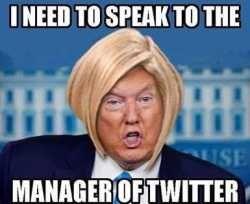
so it Looks like Trump has taken action to try and reduce the ability of big tech companies to infuse their opinion in political discourse
this is a strange and complicated subject, as it’s likely that there are compelling truths to be found from all sides and from many levels of analysis
Why would Twitter be doing something wrong?
well Twitter currently is currently the platform through which a great deal of human interaction is taking place. It has, in many regards, replaced or overshadowed other
forms of discourse, especially on political matters, and though it does not behave as a conversation encompassing all the humans, it certainly is used for quick media c
overage and to quickly report things up to the minute, leading it to be the source for much popular opinion and even news content.
It would seem that this has become the ultimate news platform, as things can be deliberated upon quickly, the opinion of some snapshot of the public, completely corrupted with bad actors, sock puppets and everything in between, is made available in the immediate. Also, it would seem that businesses are required to interact with social media platforms in order to promote themselves in a capacity to keep themselves viable or thriving in the current day’s market.
So with all of those things, people are continuously using it, and in particular this is a type of interaction which allows for an idea to disseminated and dispelled quickly, without taking a lot of time to carefully scrutinize it and consider the components from multiple angles. Because of this, things are summed up quite short, and th
e ideas can be quickly transported in what appears to be a fully fleshed out and neatly encapsulated form (but they’re all so contrived and superficial.. cursory glances at truth, for truths that are void of meaning).
Nevertheless, it appears that we’ve come to a place where conflict is arising, because they are starting to opine about and frame the things that people say, in order to make them more or less believable, or credible, and this has political implications, as well as implications for the normalization of controlled discourse.
Now, that being said, there are good reasons to believe that Twitter are in the right, and that it’s wrong to go after them with legislation, an executive order, or what
ever is being done. In particular, it’s the case for their own Free Speech and the case for free enterprise and competitive behaviour of a free market. That they are in
an economic market, trying to make money for themselves and offer something which the public is given an option, without any coercion of force, to make use of it, should they so please. And, not only that, but to make use of it without having to pay for any service, other than, perhaps, a loss of privacy to some degree, which is a part
of all interaction with the world, of course.. any world that is comprised of more than just oneself, but that’s another matter.
In any case, that they are able to make decisions about how to curate or control the presentation of the material which is on their platform, is generally congruent with
the value structure which supports the idea of having free enterprise.
When it comes to free speech, it becomes a bit more complicated, as this behaviour is a form of their free speech, but it’s also affecting the free speech of others. So
you could say, that as the participation by any one human is completely optional, this takes the weight out of the argument that they’re entitled to not have their words
editorialized by the platform itself.
At the same time, however, that everyone feels compelled to participate, to have a voice in today’s discourse, and that it leads to or informs the formulation of the maj
ority of political discourse today, performing these deliberate actions necessarily influences the opinion of the world.
These observations, which I believe reasonable, in conjunction with the observation that in order to do well in today’s economic climate, a business owner must in many c
ases participate in the primary social media platforms of the day, means that any modification of the context of material which would have otherwise existed on their pla
tform, is a form of curation and editorializing, the duty of a publisher. Some would say that it has the effect of being a technocratic stifling of free speech, but that has nothing to do with the conflict or the predicate for its elicited response.
Should Twitter given protection against legal actions made on the basis that they are disseminating information that can be argued to be unreliable, unsavoury, unsalient
, fraudulent, deceptive, harmful or otherwise providing evidence for the violation of other existing laws?
That they are framing the context surrounding the things others say, is, again, a form of editorializing.. and if this is to be done, then perhaps all publishers and edi
tors should be protected from all of those same legal actions.
Or, perhaps, should they continue to editorialize content, that then all content should be editorialized, and that perhaps each piece of content should be editorialized
in a way which illustrates two or more conflicting viewpoints on the matter. Completely unrealistic, but it’d be a fun platform (thanks Scott Adams).
Honestly, if a platform is for public discourse, you should leave people to do whatever the fuck they want, and only identify that which is an actual crime, just because
it’s in the best interest of the community which believes that the laws which it lives under. Even then, they are not police.. so I don’t think they should be held resp
onsible for the things people say and do, and that it’s up to law enforcement to detect such things and go after it themselves for actual crimes which would be occurring
irregardless of the virtual world.
But if you want to publish your opinion? Then you’re being a dick if it’s stamping on other people’s opinions. There’s always an error margin, and there’s no reason to believe that you won’t, in correcting some viewpoints, also destroy other valid viewpoints at some other times. So, choosing to do that should probably make it such that
you are not able to enjoy the application of legal clauses / portions of a legal act that are intended to protect those who we’re assuming are not disseminating their ow
n opinion.
In short, dick move, not without reason, and it makes us consider if we’re okay with living in a society where the presentation of our own opinions is curated by corpora
tions.
Could that ever be a good society to live in?
Should we protect those who create such a society?
Or should they be subject to the laws that already exist in that society?